AFUE, which stands for Annual Fuel Utilization Efficiency, is the number that tells you how much of your furnace’s fuel becomes usable heat. A furnace rated at 96% AFUE turns 96 percent of its gas into heat and loses the rest up the vent. Understanding your furnace’s efficiency rating is the single most useful thing you can do when comparing models, because it has a direct effect on your heating bill. Here is what AFUE means, where to read it, and why it matters more in a long-winter climate.
Key Takeaways
- AFUE stands for Annual Fuel Utilization Efficiency: the percentage of fuel a furnace turns into usable heat over a year.
- A 96% AFUE furnace loses about four cents of every fuel dollar, while an old 60% unit loses forty cents.
- New residential gas furnaces in Canada must be high-efficiency condensing models rated at least 95% AFUE.
- The EnerGuide label shows a furnace’s AFUE, which is the most reliable way to compare models side by side.
- A high rating only becomes real savings when the furnace is sized and installed correctly, something a furnace installation team confirms on site.
What AFUE Actually Measures
AFUE is the standard measure of furnace efficiency used across Canada, and it is worth understanding what the number is really describing.
How AFUE Is Calculated
AFUE is the percentage of the fuel a furnace consumes over a full year that it converts into usable heat for your home. It accounts for real operating conditions across a heating season rather than a single peak reading. A furnace rated at 96% AFUE delivers 96 units of heat for every 100 units of energy in the gas it burns.
What the Percentage Tells You About Waste
The part of the number people overlook is the remainder. Whatever a furnace does not convert into heat is lost, most of it escaping up the vent as exhaust. A 96% AFUE furnace loses about four cents of every fuel dollar, an 80% unit loses twenty cents, and a decades-old 60% furnace sends forty cents of every dollar straight out the flue. The higher the AFUE, the less of your heating bill is wasted.
The Furnace Efficiency Categories
Furnaces fall into broad efficiency tiers, and the tier a unit belongs to tells you most of what you need to know about its running cost.
Mid-Efficiency Furnaces
Mid-efficiency furnaces generally carry an AFUE in the low to mid eighties. They are non-condensing, meaning they vent hot exhaust gases without extracting the extra heat those gases carry. For decades this was the standard, and many older Calgary homes still have a furnace in this range or lower.
High-Efficiency Condensing Furnaces
High-efficiency furnaces carry an AFUE of 90 percent or higher, with many modern units reaching 95 to 98 percent. They use a second heat exchanger to pull heat out of the exhaust before it leaves the home, which cools the exhaust enough to produce condensation. This is why they are called condensing furnaces and need a drain line rather than a conventional chimney vent. In Canada, energy efficiency regulations require new residential gas furnaces to meet a minimum of 95% AFUE, so any new furnace you buy will be a condensing model.
| Efficiency Tier | AFUE Range | What It Means |
|---|---|---|
| Older low-efficiency | 60 to 70% | Loses 30 to 40 cents of every fuel dollar; common in decades-old units |
| Mid-efficiency | 80 to 83% | Non-condensing; vents usable heat up the flue; once the standard |
| High-efficiency (condensing) | 90 to 98% | Extracts heat from the exhaust; required for new furnaces in Canada |
Where to Find Your Furnace’s AFUE Rating
You do not have to take a salesperson’s word for a furnace’s efficiency, because the rating is published in standard places.
The EnerGuide Label
In Canada, furnaces carry an EnerGuide label, the federal government’s standard energy-rating label, which displays the unit’s AFUE so you can compare models on a consistent basis. When you are weighing two furnaces, the EnerGuide label is the most reliable side-by-side comparison you have. Some high-efficiency models also carry the ENERGY STAR mark, which is awarded only to units above the standard minimum.
Checking the Rating on an Older Furnace
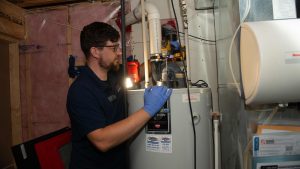
If you want to know how efficient your current furnace is, the rating plate inside the unit or its model number can be used to look it up. A licensed technician can confirm the efficiency of your existing system during a service visit and tell you how it compares to what a replacement would deliver.
What a Higher AFUE Means for Your Heating Bill
The practical reason AFUE matters is money, and the effect is larger where the furnace runs for most of the year.
Why Calgary’s Climate Amplifies the Difference
In Calgary, a furnace works for six to seven months of the year. The longer it runs, the more fuel it uses, so a few percentage points of efficiency add up to more here than in a mild climate. Upgrading from an aging mid-efficiency unit to a modern high-efficiency furnace can noticeably reduce the fuel portion of your heating bill over a full season.
Why the Payback Depends on Your Home
How quickly a more efficient furnace pays for itself depends on your home’s insulation, how well it is sealed, and how efficient your current furnace is. A home losing heat through poor insulation will not realize the full benefit until those losses are addressed, and even the best unit underperforms at the wrong furnace size. The rating and the home work together, which is why an on-site assessment gives a more honest estimate of savings than any number on a label.
Frequently Asked Questions
What Is a Good AFUE Rating for a Furnace?
For a new furnace in Canada, 95% AFUE is the minimum, and ratings of 96 to 98 percent are considered high-efficiency. Anything below 90 percent is an older, non-condensing design that wastes more fuel.
Is a 96% AFUE Furnace Worth It Over a 90% One?
In a cold climate where the furnace runs for much of the year, the higher rating uses less fuel over each heating season, so the gap matters more here than in a mild one. Whether it is worth the price difference depends on your home and how long you plan to stay.
Does a Higher AFUE Furnace Lower My Gas Bill?
Yes, a higher AFUE means more of the gas you pay for becomes heat and less is wasted, which lowers the fuel portion of your bill. How much you save depends on the efficiency of the furnace you are replacing and how well your home holds heat.
Does Furnace Staging Change the AFUE Rating?
No. AFUE measures fuel converted to heat, while staging describes how the furnace delivers that heat. Two furnaces with the same AFUE can run differently depending on their staging.
Get the Right Efficiency for Your Calgary Home
AFUE lets you compare furnaces honestly, but the rating only turns into savings when the furnace is sized and installed correctly for your specific home. The most reliable way to know what efficiency gain makes sense for you is to have a licensed technician look at your current system and your home together.
Quicker Rooter has been installing and servicing furnaces across Calgary for over 30 years. Our licensed technicians explain your efficiency options clearly, size the system to your home, and install it properly, backed by a one-year warranty on parts and labour. Learn more about our furnace installation and repair services, or contact us to talk through what fits your home.
Sources
- Natural Resources Canada – Furnaces and the EnerGuide label, defines AFUE and how furnace efficiency is rated
- Natural Resources Canada – Gas furnace efficiency regulations, confirms the 95% AFUE minimum for new residential gas furnaces
- Natural Resources Canada – ENERGY STAR Canada, explains the ENERGY STAR mark for high-efficiency heating equipment